Quantitative analyses on the global coronavirus pandemic

Author: William Ku Page 9 of 12

Eight Renegade States Have No Statewide Lockdowns

While 95% of the US is locked down now, and the President is pushing the governors to make plans to re-open their states for business, eight states have yet to institute a statewide lockdown or closure of non-essential businesses and stay-at-home order.  These states are all infected and may experience uncontrollable outbreaks in the near future.  All of them have made some efforts to mitigate the pandemic and three of these states (highlighted in pink in the table below) have partial lockdowns for certain cities and counties within their state imposed by local governments that help to mitigate their risk.  But unless they take quick and decisive action to lockdown their state in full they will continue to expose their residents to unnecessary deaths and expose the entire country to re-infection even as the US daily confirmed case count appears to be topping out

StateInfections
/million
InfectionsDeathsMortality CoincidentMortality EstimatedTesting
/million
% Test
Positive
SD        1,351116860.5%4.0% 11,14412%
UT           8352542200.8%3.5%14,8526%
IA           6371995532.7%4.0%6,29710%
OK           57822631235.4%7.0%7,3848%
AR           5351599342.1%4.0%7,2357%
NE           500952212.2%3.0%6,0638%
WY           49528820.7%3.0%10,9355%
ND           48536592.5%4.0%14,8503%

Six out of the eight states (top 6 out of 8 rows in the table above) are seriously infected already and will have to institute state-wide lockdowns to control the spread.  Two of these, South Dakota (SD) and Iowa (IA) may suffer very badly before they gain control of their outbreaks.  No other state has ever let their infections get as bad as SD before imposing state-wide lockdown and only one state, New York (NY), locked down after where IA is today, and no one wants to follow in the footsteps of the tragedy in NY.  Our forecast for SD and IA is that before it all ends this year more than 1% of their population will be infected and more than 400 per million of their citizens will die.  Relying on good behavior and herd immunity does not work as evidenced by Sweden, and we urge the legislators and citizens in these states to warn their governors to act before it is too late for them and for the rest of the country.
COVID-19 Testing in the US Still Has Issues

Two weeks ago we posted a commentary about the importance of quick, accurate and thorough testing in the war against COVID-19 and suggested that after an abysmal start the US was finally on the right track.  We are less optimistic now — particularly after reading about the President’s recent appeal to the South Korean government for 600,000 test kits.  What is the problem with the much-touted US COVID-19 testing program? 

The figure above shows that after a slow start in February and through early March, cumulative testing (blue circles) accelerated exponentially from early to late March when its growth slowed again.  Since April 9th when daily tests peaked (brown squares against left axis in the figure below) at 163,172 completed tests, testing has steadily declined to 129,854, yesterday.  This is highly concerning since the President and some governors have promoted the accessibility, speed, and accuracy of US COVID-19 testing for many weeks.  Moreover, if US testing has hit another bottleneck due to lack of testing personnel, equipment and/or supplies, some of the recent declines in daily confirmed case count may be artificially hiding an underlying increase in real daily COVID-19 cases. 

To check this possibility we looked at the percentage of tests that are returned positive (blue diamonds in the figure above plotted against the right axis) over the last six weeks. Back in early March testing was definitely constrained and on several days the percentage of positive results approached 20%.  Then as the US ramped up testing by permitting commercial labs to run these tests and removing the CDC as the bottleneck, the percentage of positive test results fell below 10% for many days near mid-March indicating that we were beginning to test many weakly symptomatic or asymptomatic cases.  However since then the percent positive has climbed back to 20% in early April and stayed above 1 out of every 6 tests.  Compared to best in class countries such as Taiwan (1in 118), South Korea (1 in 49), and Singapore (1 in 25) this is still abysmal performance. Compared with good European nations such as Norway (1 in 19), Germany (1 in 10) and Austria (1 in 10) our record is still bad.  As we mentioned yesterday in regards to the UK, countries with a high percentage of positive results usually have very high mortality rates either because they have not measured all those that have been infected by a coronavirus (leading to an artificially low denominator), or they have truly let this asymptomatic portion of the population silently infect and kill many older and vulnerable citizens.  We need to at least double our testing to 300,000 per day to match the effectiveness of the best Europeans at uncovering most if not all COVID-19 cases in the US.

There are some states that are much worse than average on this metric.  New Jersey (NJ) and New York are the two worst states with 50% and 41% cumulative positive test results, respectively.  Moreover, on a daily basis, NJ has gotten worse.  On April 13th, 69% of all completed tests on that day came back positive.  NJ has one of the more restrictive COVID-19 testing protocols that could be missing half of all cases including many that are asymptomatic or weakly symptomatic.  This means that the true infection rate in NJ is probably at least double that of the 0.73% currently reported.  The NJ governor has recognized this problem and has ordered 15 Abbott ID NOW machines from the Federal government on April 10th to augment NJ’s stressed testing program.   It is unclear when relieve will come and when they will be able to get an accurate picture of their infected population.

Why Is California Doing So Much Better Than New York?

Many analysts have asked why is California (CA) doing so much better than New York (NY) in this pandemic.  NY experienced its first case on March 1st, while CA experienced its first case earlier on January 26th.  In both states, the infection did not become obviously serious until March 11th when the infection count crossed 200 cases in both states.  On March 19th when CA confirmed case count reached 25 per million population Governor Newsom declared a lockdown in CA.  On March 22nd, NY had already reached an infection rate of 812 per million before Governor Cuomo declared a lockdown.  Thus, even though NY was only 3 days behind in enacting strong mitigation measures, it was 33 times more infected by then and that much further along the exponential growth curve.  In the early days of an infection’s exponential growth phase quick and decisive action is crucial.  NY’s slower response then has led it to have a measured infection rate that is 16.2 times worse than CA now. 

StateInfections
/million
InfectionsDeathsDeaths
/million
Mortality CoincidentMortality EstimatedTesting% Test PositiveMedian Age
NY      10,441    203,12310,834        5575.3%7.1%2.6%41%39.0
CA            646      25,536 782          203.1%4.2%0.5%13%36.8
=NY/CA16.228.1

In addition the NY situation was complicated by its strong infection epicenter in metro-New York City (NYC) which involved a strong-willed mayor and two other governors who needed to cooperate to shut down the entire region to prevent cross-infection.  This did not actually happen until March 23rd when CT locked down and NY state infection had already reached 1073 per million.  These delays have cost NY thousands of unnecessary lives.  We had urged the government to act forcefully on Mar 9th.  Had any of them acted then, much of the tragic loss of lives could have been avoided and we would have been 2 weeks further along on our recovery. 

The magnitude of the difference between the two states is actually more than a factor of 16.2. NY’s death count per million is 28.1 times worse than CA.  Some of this difference may be due to the younger population in CA (36.8 vs 39.0 yrs) especially in Santa Clara County where many of the early CA cases were located.  But the delayed reaction in NY that led to overwhelmed hospitals and testing facilities in NY might have also played a part.  When you look at the number of tests performed in NY vs CA it might look like NY is doing better with 2.6% of its population now tested against just 0.5% of the CA population tested to date.  But this not the best metric to compare.  When the infection rate is higher you need to test more to prove that you have tested all the mild and asymptomatic cases.  The percentage of all tests that yielded a positive result is a measure of how thoroughly a state has tested its population.  On this measure, CA is doing better than NY with 13% of completed tests yielding a positive result compared to NY’s 42%.  NY’s number shows that it is probably only testing the most seriously ill patients and not probing the true spread of the disease in NY.  Thus the true infection rate in NY might be 2% of its population and the ratio between the 2 states may well be not just 16.2 times but 25 to 35 times worse in NY.  This would mean that NY with an infection rate that was 33 times worse at the time of lockdown has continued to maintain that same ratio of infection disadvantage 3 weeks later.  Other considerations such as socioeconomic factors like race, income, and behavior, as well as population density, probably also matter but we argue that all the observed differences could be just due to the math of exponential infection.  

NY suffers from the terrible legacy of delayed and botched testing and delayed and weak lockdown decision-making during a pandemic which has carried through to this day.  Of course, things could have been much worse for both states if the local and state governments had waited for the President to act.  Both states would have been still experiencing exponential growth instead of showing clear signs of a top last week (see figure above).

The UK Is Improving but Cannot Avoid a Major Disaster

Currently, the UK lags behind many countries such as the USA, Italy, Spain, and France in terms of cumulative deaths from COVID-19, but we project that it could wind up with one of the worst deaths per million statistics for a major country.  The reason is that their newly confirmed case is only beginning to peak and the daily death count has yet to peak.  This coupled with an estimated mortality rate of 20% puts the UK on track to suffer over 500 deaths per million, up from its current value of 157.

How did one of the most scientifically advanced countries get into this mess?  Part of the answer lies in the government’s weak and slow response to the pandemic.  In fact, the government’s initial approach was to let “herd immunity” solve the problem by allowing the virus to run rampant throughout the country.  Eventually, Boris Johnson changed course after the public got wind of his inhumane strategy and especially so after he got the virus himself.  But the change in course beginning in mid-March and culminating on March 23rd with the passage of the Coronavirus Act 2020 could take a few more days to show up in a peaking death count.  The fact that they did institute a national lockdown, albeit late, may help them relative to a country like the US where we still lack a national lockdown policy.

A major reason why the British situation is so dire is that their testing is way behind where it needs to be.  Among the major countries with infections greater than 1000 per million, they have the lowest test rate — 5,200 per million.  The more infections per capita the greater the need to test and the inverse ratio of the two is an abysmally poor 4.2 in the UK.  This means that every fourth patient they test is infected and implies that they are missing a lot of asymptomatic or weakly symptomatic patients that can nevertheless infect many others.

A major reason their estimated mortality is so high is that the number of hospital beds per capita is a poor 2500 per million – lower than Spain or Italy.  They will soon run out of hospital beds to care for all their sick patients and the mortality rate could go up even higher as a result of poorer care.

This exposes the fallacy and tragedy of the herd immunity approach.  Humans cannot allow their fellow humans to die in the field like cattle, they want to help and ease their pain and suffering.  Moreover, way before the UK will reach herd immunity, they will run out of hospital beds and people could die in the streets. 

CountryInfections
/million
InfectionsDeathsMortality CoincidentMortality EstimatedDeath
/million
Tests
/million
H Beds
/million
Spain       3,567 166,83117,20910.3%13%   367.9   7,5932970
Switzerland       2,970    25,4151,1064.4%5%   129.3 22,3934530
Italy       2,579 156,36319,89912.7%15%   328.2 16,7083180
Belgium       2,558    29,6473,60012.1%15%   310.6   8,8145760
France       2,036 132,59114,39310.9%14%   221.0   5,1145960
U.S.       1,697 560,40222,1053.9%6%      66.9   8,5572770
Austria       1,551    13,9453502.5%3%      38.9 16,0867370
Germany       1,527 127,8543,0222.4%3%      36.1 15,7308000
UK       1,243    84,27910,61212.6%21%   156.6   5,2002500
Norway       1,206      6,525 1282.0%2%      23.7 23,3323600
Iran          857    71,6864,4746.2%7%      53.5   3,1361600
Singapore          438      2,53280.3%1%        2.3 12,4232900
S. Korea          203    10,5122142.0%2%        4.1 10,03812270
Taiwan            16         38861.5%2%        0.2   1,9547100

Pandemic Shows Signs of Peaking in the USA

Just last week, we posted an article that suggested the US is making progress in the war against COVID-19.  Now there are clear signs that we have reached the peak of the infection and now are on the backside of the pandemic in the US.  The following graph shows new daily COVID-19 cases (brown squares) that shows a broad peak around April 7th.  The blue diamonds show a broad peak in the daily death count occurring now, 5 days later, around April 12th.   You can see that the death count lags the case count by about 5 days as deaths occur on average about 5 days after diagnosis.  You can also see that the best estimate for the true mortality rate is 5.5% (as the death count is plotted against the right vertical axis that is just 5.5% of the left vertical axis).  This is much higher than the coincident mortality rate of 2.3% that is usually quoted in the media.

This broad peaking in the case count and the death count does not mean the danger is over by any means for the US.  This does not mean that we can reopen the country soon, but it does mean that we may reach the peak resource usage requirement by month-end and achieve some measure of control over this virus.  Peak resource usage will correspond to a top in the active case graph below — i.e., cumulative cases to date minus deaths and cures, or resolved cases.  Because we had multiple hotspots already before the government acted strongly, and because we still lack a national lockdown policy we are not likely to track the near-ideal curve of the South Koreans but more like the flattened, slowly declining curve like the Italians.

This means that it would be far too early to talk about re-opening the country on May 1st.  In fact, we had suggested before that the strategic way to open is to make sure that we have tested the country widely for newly infected cases, track all their contacts, and strictly quarantine them all before any consideration of reopening the country or even lifting the social distancing and congregation recommendations of <10 people.  In the interim, if tests for antibodies in those already infected prove reliable, we can let those people resume normal activities first.  This whole process could take another month and a half before we can consider a general re-opening of the country by June 1st.

Italy’s COVID-19 War Continues to Show Progress

On March 23rd we pointed out positive signs of progress in Italy’s tragic war against COVID-19: (1) a bend in the confirmed case curve, and (2) the ability of small towns in Italy to control their outbreak with widespread testing and targeted quarantines.  We predicted that clear signs of a turn would occur in early April due to the imposition of stronger national travel restrictions on March 8th. More than a few people were skeptical about this “peaking” or “bending” of the curve. 

Moreover, there is a lot of confusion about the terminology bandied about in the press and by the President. Peaking is often not the sharp rise and fall connoted by the colloquial use of the word, but more like a broad topping of the case count or death count lasting weeks rather days.  In fact, a broad topping or a flattening of the curve is what is preferred to ease the load on medical facilities.  In the figure above the plot of daily confirmed case count (brown squares) seemed to spike to 6,557 on March 21st but really the peaking occurred on Mar 24th and it was a broad peak lasting more than a week (best fit brown curve) with several subpeaks as the infection peaked in one area (Lombardy), then another and then a third and so on.  We expect the overall case count to continue to fall, but with additional smaller peaks and dips as cities get infected and gain control over their infections.

Secondly, there is a marked difference between peaking in terms of confirmed case count and death count.  Deaths usually occur 3–7 days after a case of infection is confirmed and can range from -1 to 21 days before resolution – the short end is due to cases confirmed after death and the long end is due to the time that it takes for many cases to resolve themselves into deaths and cures.  Thus our preference to use a lagged5 mortality rate calculated from the current death count divided by the number of cases averaged 3–7 days prior.  In the figure above, the death count (blue diamonds) spiked to 919 on March 27th but exhibit a broad peak (best fit blue curve) centered around March 29th — 5 days after the broad peak in confirmed case count.  Again this broad peak shows waves of subpeaks and dips as individual towns experience and manages their outbreak.  One other thing to note is that the death count plotted against the right axis shows that about 15% of all confirmed cases result in death so the mortality rate is close to 14.8% rather than the 12.6% calculated from the current death count divided by current case count. The next important milestone to look for is when the net number of daily cases falls below zero, ie there are fewer new cases than resolved cases (deaths plus cures) so that the hospital facilities will have passed peak utilization.  We forecast this should happen in the next 7–10 days.  By the time Italy can be considered to have gained control of this outbreak in early May (daily count below 1% of the peak ~65) we expect 160,000 cumulative cases and 24,000 deaths.  When and if travel restrictions are lifted infection might reoccur so diligent testing, tracking, and treating will still be required until a vaccine is made available next year.

This pattern of broad peaking in the confirmed daily case count and the subsequent daily death count is what we expect to see in the US later this month.

Sweden and Norway — a Contrast in Strategies and Outcomes

On March 14th we noted how remarkably low the Scandinavian countries’ COVID-19 mortality rate appeared to be (although we cautioned that the statistics were weak and results could easily evolve).  Since that optimistic start Sweden has chosen a highly unusual strategy to deal with the Pandemic and as a consequence, has achieved very different results than Norway and Denmark.   

While Norway and Denmark closed their borders, restaurants and ski slopes and told all students to stay home in March, Sweden shut only its high schools and colleges, kept its preschools, grade schools, pubs, restaurants, and borders open and put no limits on ski slopes. In fact, Sweden and Brazil are the only two major countries in the world that have not imposed any lockdown of significance.  Sweden has chosen a strategy that Boris Johnson had intended to employ in the UK but quickly abandoned when the public got wind of the herd immunity theory backing his minimalist approach.  Sweden’s rationale for this approach is not herd immunity — at least in the public defense of their laissez-faire approach.  Their argument is that the Swedish have always complied with government recommendations so they feel that advising people to practice social distancing and not to travel should be sufficient to slow the virus so that their hospitals can handle all the sick patients appropriately.  Eventually, herd immunity will take over and stop the Pandemic.  This approach looks like it is heading over the cliff.

All three countries have experienced very high infection rates as most EU countries have due to their initial open border policies.  While Sweden has continued to maintain open borders, Norway banned non-residents from entering the country on March16th after they had locked down most of the country’s institutions on March 12th.  Their infection curve basically peaked broadly on March 29th. Sweden’s infection curve has still yet to peak reaching 726 newly confirmed cases today, April 8th.  

CountryInfections
/million
InfectionsDeathsMortality
Coincident
Mortality
Estimated
Deaths
/million
Tests
/million
Serious
/Critical
Norway        1,125       6,0861011.7%2.0%          19 21,009        78
Denmark            934       5,4022184.0%6.3%          38 11,050     127
Sweden            835       8,4196878.2%12.5%          68    5,416     678

The table above shows that all 3 countries’ infections per million population are near 1000.  However, the death count per million is significantly higher for Sweden (68) than for Denmark (38) or Norway (19).  This is associated with the significantly higher mortality rate for Sweden — which we estimate to be a very high 12.5% — nearly as high as that for the tragedy in Spain, 13.2%.  There is nothing in the gross demographics that could explain this huge and statistically significant discrepancy between Norway and Sweden such as (1) median age: 39.8 vs 41.1, or (2) net migration: 28,000 vs 40,000 for Sweden, or (3) urban concentration, both near 83%.  However, Norway has done a much better job of testing its population with 21,009 tests per million citizens. Moreover, Norway also has a much smaller number of critical patients that could turn into deaths over the next week.

Sweden has not published its death statistics but we would bet that a significant portion of their dead is older and/or have comorbidities.  Older people were asked but not compelled to isolate themselves.  When everybody else is in the public square enjoying a nice day this past weekend in Stockholm, the elderly also joined the crowd.  This intermixing is deadly for the elderly but somehow the advice did not get through that they need to isolate and stay home.  This is the problem with an advisory vs a government-mandated shutdown.  Moreover, their advisory was only for those 70+, clearly not considering the Italian data that show people in the 60-69 band had a mortality of 7.1%.  Sweden needs to widen its testing immediately, to impose stringent travel restrictions to permit only essential businesses to operate, and to reduce the congregation maximum from 50 to 2. 

This has been a very expensive experiment by the Swedish government that will eventually cost over a thousand unnecessary Swedish deaths even if they corrected themselves tomorrow.  The longer they delay the higher the cost in terms of lives lost.

Progress in War Against COVID-19 in USA

There are early signs that the COVID-19 Pandemic in the USA may turn this coming week — at least in terms of newly confirmed cases.  The underlying doubling rate has slowed from 6 to 7 days. This is partially due to the rapid catch up in testing that has occurred over the last few days/week. The peak in daily death counts may happen in 2 weeks.  Cumulative death counts will continue to rise every day into May and June and the total may shock Americans, but the rate of increase should slow.

The reason for optimism is three-fold:

  1. By the end of this week, testing should have caught up with best-in-class Germany with more than 3M Americans tested.  Currently, 1.8M or 0.53% of all Americans have been tested.
  2. More than 41 states have lockdowns in place of one sort of another with >90% of Americans under lockdown rules.  Florida governor finally agreed last week.
  3. Social distancing, while not perfect, is 90% compliant.

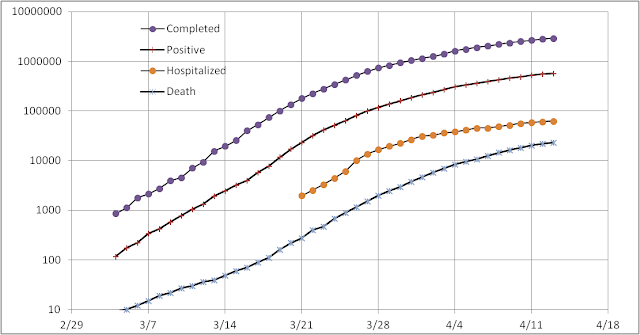
This may be a false Spring but if it is confirmed over the next few days, the turn could be real.  As testing improves, the country should widen the net to catch asymptomatic cases and improve tracking of all known contacts.  There is strong evidence that this is already happening.  The percentage of all tests returning positive dropped from a peak of 17% five days ago to just 12% yesterday.  In the figure below note that the line tracing the number of cumulative hospitalizations or serious cases (brown dot) is bending away from the number of cumulative positive cases (+sign).  This means that more and more cases not requiring hospitalization are being identified.  The death count (*sign) continues to rise exponentially but this is a lagging indicator — reflecting cases confirmed a few days to a few weeks ago.

When more and more asymptomatic carriers are identified and tracked the country may revert to selective quarantines and lift general quarantines — possibly in May.  All lockdowns may be lifted by June if we maintain social distancing.  In the meantime, everyone must practice social distancing diligently for two more months.  Stay at home if at all possible.  There are people complaining that the country cannot be locked down for 3 months to a year and they cannot practice social distancing that long.  Tell them 2 months is not forever.  This forecast is for the country as a whole so there will be pockets of hot zones still left in the USA that must be defended against vigorously since the country lacks a nationwide lockdown.  

Some Countries Fare Better in the COVID-19 War

In previous posts, we had pointed out that certain countries such as South Korea, Singapore, Germany, Austria, and Scandinavian countries appeared to have done significantly better than other countries such as Italy, Spain, France, and the UK in the war against the COVID-19 pandemic.  This pattern of success has persisted through the last few weeks of exploding cases for many but not all of them.  It turns out that the Scandinavian success was a statistical fluke and short-lived except for Norway who continues to lead all European countries with the lowest coincident and estimated final mortality at 1.1% and 1.4% respectively.  This was initially attributed to the youth of its original infectees, skiers, but since more than 0.1% of the country’s population has now been infected we believe it may be more representative of the country as a whole.  Germany and Austria follow close behind with coincident and estimated final mortality rates near 1.5% and 2.0%, respectively.

Much has been made of Germany’s early testing and tracking.  But unlike South Korea and Singapore, they did not test as widely nor did they isolate or restrict the travel of their potential infectees as well as South Korea Singapore, and Taiwan.  This was partly because as members of the European Union they had tried to maintain open borders for as long as possible, but also because the Germans had initially underestimated the severity of the disease. So while South Korea was able to maintain both a low population infection rate of 196 per million and a low death count of 3.4 per million, Germany’s later imposition of international and domestic travel restrictions led to a cumulative infection rate of 1,148 per million and a current death rate of 17 per million that is sure to rise higher to perhaps 30.  But these numbers are or will still be nearly 10 times better than what we see and estimate for Italy, Spain, France, and the UK (whose current death count is just 64 only because their infection is still in the early stages). 

CountryInfections
/million
InfectionsDeathsMortality CoincidentMortality
Estimated
Death
/million
Spain          2,697     126,16811,9479.5%13.6%255.4
Switzerland          2,397       20,505            6663.2%4.2%    77.8
Italy          2,056     124,63215,36212.3%15.1%  253.4
Austria          1,310       11,781          1861.6%2.0%    20.7
France          1,381       89,953  7,5608.4%16.3%  116.1
Germany          1,148       96,0921,4441.5%2.1%    17.3
Norway          1,026          5,550            621.1%1.4%    11.5
U.S.             943     311,357  8,4522.7%5.1%    25.6
Iran             666       55,743         3,4526.2%8.3%   41.3
UK             618       41,9034,31310.3%19.0%   63.6
Singapore             206          1,18960.5%0.7%     2.3
S. Korea             196       10,1561771.7%1.8%     3.4
Taiwan               16             355      51.4%1.4%     0.2
China               57       81,639   3,3264.1%4.1%    2.3

Again, the lessons to be learned from observing these countries’ results is that:

  1. Testing, tracking, and treating (3T) early and widely and thoroughly will help to lower both infection rate and mortality rate — as South Korea, Singapore and Taiwan have done.
  2. Some errors or delay in implementing the 3T can be ameliorated with early and stringent travel (the 4th T) restrictions or quarantines — like Germany, Austria, and Norway has done.  They have high infection rates but still reasonably low mortality rates.
  3. Failing to follow this 4T prescription until very late will lead to disasters like those we are seeing in Italy, Spain, France, and the UK.  The incremental loss in lives is at least 10–1000 times worse and totally unnecessary.
  4. The US is currently at an infection rate of 943 per million and a current death count of 25.6 per million.  It is projecting a final death count of 300–720 per million.  It can avoid the worst-case but it needs to act now to impose stringent domestic travel restrictions.

Florida’s Prospects in the COVID-19 War Have Improved

Several important developments in Florida’s war against COVID-19 have made us much more sanguine about its prospects for controlling the Pandemic.  Testing, travel restrictions, and social distancing have all improved. 

Testing has improved — nearly doubling over the last 5 days from 41k to 77k cumulative tests.  But Florida still lags other states such as New York, testing only 0.36% of Floridians while the latter has tested 1.22% of all New Yorkers.  Florida’s testing protocol is still too strict — missing many potential carriers that do not show symptoms.  Until testing becomes more widespread we still have to rely on general travel restrictions to contain the virus.

Travel restrictions have been tightened significantly with Governor DeSantis finally recognizing the severity of the problem and declaring a statewide stay-at-home policy starting today, April 3rd.  The policy is somewhat leaky because it allows religious and golf club assemblages that could permit the virus to spread.  But it is a significant improvement over the patchwork of county and city travel restrictions that existed before that led to ridiculous pictures of half-closed beaches because the beach was in two counties with different policies.  This will also reduce the chance that Seminole County will reinfect Orange County even if the latter tamped down its infection. In addition, statewide shelter-in-place announcements by Georgia, Florida’s neighbor, should also help to lower the risk of reinfection.  While the country lacks a nationwide lockdown policy, governors have now restricted travel for 90% of the US population.  Even so, without a nationwide lockdown, we still have to rely on voluntary social distancing.

Individuals have improved social distancing as the number of COVID-19 skeptics dropped throughout March. While social distancing became 90% effective in New York City and San Francisco by March 16th, it did not take hold in Orlando, Tampa, and Miami until a full week later on March 23rd.  The positive impact of social distancing has shown up in smart thermometer maps of U.S. where California has improved but Florida is still hot.  100% voluntary compliance is still hard to achieve especially with young adults, but many states are cracking down on violators with social shaming and fines. 

Given all these positive developments, Florida’s prospects for controlling the COVID-19 Pandemic has improved.  While we are still forecasting exponential growth of confirmed cases as testing catches up with reality and shelter-in-place kicks in over the next 2–3 weeks, cumulative case count, currently near 9k could show a marked slowing as it approaches 100k by the end of this month.  At his point, daily case count will start to decline until the end of May when the infection might be considered under control.  Hopefully, Florida hospitals can handle the increased caseload (currently at 1,167 hospitalizations out of 17k beds available) so that the death count could be held under 6k.

Page 9 of 12

Powered by WordPress & Theme by Anders Norén