Quantitative analyses on the global coronavirus pandemic

Category: Blog Page 7 of 12

COVID-19 Continue to Surge in Florida

The number of daily confirmed COVID-19 cases in Florida and several of its major cities such as Miami, Tampa, and Orlando continues to rise exponentially (with Orlando showing a doubling time of 4 days). The latest data shows a surge to record high levels (7-day average) in Orange (brown squares against right axis) and Miami-Dade (blue diamonds against left axis) Counties. 

Orlando, Tampa, and Miami are now more dangerous than any part of Metro-NYC is, and Florida is now hotter than any other state (as indicated by its doubling time of 9.5 days, which is the shortest of any state).  COVID-19 cases surged and will continue to surge higher in Florida for the following reasons:

  1. Huge crowds on Florida beaches for Memorial Day weekend, 5/23-25 that showed up as new cases beginning in June
  2. Hundreds of thousands watching SpaceX launch attempts on 5/27,5/30 without masks and social distancing on the Space Coast that showed up as new cases in Orlando
  3. Ongoing protests against racial injustice soon after George Floyd’s death on 5/25 that are showing up as increased case counts now.
  4. Universal Studios reopened on 6/5 and Disney World will reopen on July 11th .
  5. Florida entered Phase 2 reopening on 6/5 (with the exception of Palm Beach, Broward, and Miami-Dade counties that are now in Phase 1).
  6. The spread of the Pandemic to Latin America in May that led to the recent travel ban from Brazil that should have also been applied to other countries such as Peru, Chile, Mexico, Ecuador, Colombia, etc.  Hundreds of millions of Latin Americans visit Florida (mostly Miami and Orlando) each year.

The novel coronavirus can take about 5–14 days to incubate before an infected person starts showing symptoms and register as a confirmed case.  So even though case counts stopped declining and started to rise slowly shortly after May 4th reopening (see figure below) it did not surge until later in May.  Moreover, this resurgence in cases is not confined to the three hot counties of Palm Beach, Broward, and Miami-Dade but it has spread to Hillsborough, Orlando, Pinellas, and the rest of Florida.  The brown squares track the number of daily new cases (left axis) and the blue diamonds track the number of daily new deaths (right axis).  The case fatality rate (CFR = deaths divided by cases) has held near around 4.5% (the ratio of the right axis to the left axis) with deaths lagging case identification by about 2 weeks.  The first broad peak in Florida case counts occurred around 4/12 a broad peak in death count followed on around 4/28.  The death count has averaged near 33 per day for the last 5 weeks, but we expect it to rise slowly in the next few weeks as cases turn into deaths or recoveries. Increased testing should have identified milder and asymptomatic cases associated with younger adults, so the CFR should be lower. 

The recent resurgence in hospitalizations, however, makes us very pessimistic about Florida’s prospects.  The brown squares (7-day averages) below show an increase in new hospital admits over the last two weeks and reached 200 yesterday.  Yesterday 21,559 tests resulted in 17.7% positive cases – a terrible deterioration in the positive test rate from a low of 3% reached on 5/23. 

The recent decision to hold the GOP Convention to Jacksonville will exacerbate the problem for Florida.  The Governor of Florida promised to let the data and science guide reopening so he needs to halt reopening plans to assess the new COVID-19 outbreaks and make sure that testing, contact tracing, and selective isolation can keep up with the recent surge.  The Mayor of Miami has already done so.  If nothing is done statewide, the state may need to lock down again next month to prevent thousands of more Floridians from needlessly dying.   

USA Is Failing to Protect Its Most Vulnerable

The number of COVID-19 confirmed cases are rising alarmingly in many parts of the US.  Many of the governors explain away the rise as a result of increased testing.  To some extent this is true.  The number of tests per day has increased from an April plateau around 150,000 tests per day to near 600,000 tests per day (brown squares against the left axis plotted in thousands in the figure below).  This occurred despite the President’s constant criticism of testing for Americans even as he requires everyone around him to be tested multiple times a week.  Some governors base their claim of victory on this improving trend as the average percent of positive results (blue diamonds against the right axis) have fallen below 5% in June for the US as a whole.  Many epidemiologists believe that driving this number below 1% as South Korea and Australia have done will be required to truly control the pandemic. A few states are close to achieving this target but most are not.  

In addition, some governors point to the fact that widespread testing has allowed them to sample more mildly symptomatic and asymptomatic cases, who are generally younger adults.  So all this testing has increased case counts but not hospitalizations and eventually death counts.  They conclude this is all good because this will lower the case fatality rate (CFR) for their state and show that they are managing their epidemic better. 

Unfortunately, this approach makes it extremely difficult for older and more vulnerable Americans to survive.  The strongest driver of COVID-19 mortality is age with the same phenomena seen in every country.  In California those over 80 yrs old are over 1000 times more likely to die (36%) than those younger than 17 yrs old (< 0.03%).  So many young people flaunting the rules of masking and social distancing (encouraged by the President and his allies) which is causing a higher percentage of the population to become infectious.  More vulnerable Americans will also get COVID-19 and many of them will die.  In fact, hospitalizations are now edging up in Florida, Arizona, Texas, California, and many other states.  This laissez-faire attitude was also adopted by Sweden and Brazil where effective lockdowns were never imposed.  Now more Swedes are realizing that their government has failed to protect its most vulnerable.  Mahatma Gandhi suggested that “the true measure of any society can be found in how it treats its most vulnerable members.”  Currently, this country is not adequately protecting those who are most harmed by the pandemic, including sick, old, poor, and black Americans.  Worse, this President is actively working to disenfranchise the most vulnerable, by continuing to fight against mail-in voting, their only means to vote safely in a Pandemic.

What Second Wave? The US Is Not Done with the First Wave

We pointed out earlier that if one looks at the US outside of New York (NY) and New Jersey (NJ) (or more precisely outside of Metro-NYC), the country’s COVID-19 pandemic has not peaked but rather has plateaued since mid-April.  Some states outside of NY and NJ appear to have also peaked but the 3 biggest states in the US, California, Texas, and Florida — containing 25% of the country’s population, has not really peaked and are experiencing continued increases in daily confirmed cases.  The figure below shows the daily case count for these 3 states:

California (CA — blue diamonds in figure above with 7-day rolling average), after plateauing in early April, has seen rising case count since mid-April.  Part of this rise has been due to increased testing but while testing has definitely improved it cannot account for all the increases in infections.  Some of it has been due to a series of politically motivated miscalculations undertaken to reopen the state since early May and testing and contact tracing missteps.  In addition, since Memorial Day, the massive crowds at the beaches and at the demonstrations against racial injustice and police brutality have just begun to feed into higher infection rates this month and into Summer.

Texas (TX – red squares) after initial infection plateaued in mid-April has experienced waves of additional infections ever since Phase 1 reopening began on May 1st.  Governor Abbott just widened the reopening to Phase 3 on June 3 with little regard for the alarming trends in infections.  Texas has just reported its highest rate of hospitalization rates since the Coronavirus began spreading but officials have no plans to slow reopening.  Yesterday, 2166 COVID-19 patients were hospitalized and Texas ICUs are reportedly at 88% capacity.  So while its Deaths per million population and Case Fatality Rate (CFR in table below) has been relatively benign due to its relatively young population (median age of 34.8 yrs), it should not want to see its ICU flooded with more cases.

Florida (FL – green triangles) showed some evidence of peaking in case count in early April that led to halving of infections by early May.  However, as soon as the state reopened on May 2nd the case counts leveled off and by the end of May begin to rise again for a wide variety of reasons.  More recently the rise has begun to look exponential with an effective reproduction rate of R=1.18 and a doubling time of 13 days (see table below).  This does not bode well for the GOP convention now scheduled for August in Jacksonville.  If they do not enforce testing, masking, and social distancing it could spell disaster for the GOP, city, state, and country. 

StateInfectionsInfections /millionDeathsDeaths
/million
Fatality
(CFR)
% Test
Positive
Median AgeRDoubling time(days)
CA   147,132       3,724  4,988        1263.4%5.5%36.81.0833
TX     85,641       2,954  1,966          682.3%6.8%34.81.1420
FL     70,971       3,332  2,877        1354.1%5.4%42.21.1813

While CA, TX and FL had the 3 highest single day totals yesterday, North Carolina, Arizona, and Arkansas also saw large increases (~0.02% of population) recently.  Other states such as Oregon and Utah have prudently paused reopening plans as they investigate recent surges.  Those who are not pausing are inviting disaster because the slower one reacts, the more drastic the measures one needs to apply to stop any outbreak. 

COVID-19 Still Dangerous in the USA

After a slow start, the US has made good progress in the last couple of months against the COVID-19 pandemic.  Confirmed case counts per day have declined to 20,000 after peaking near 35,000 in early April (brown squares against the left axis in the figure below).  

Over the same time period, the number of tests conducted per day increased from 100,000 to near 500,000 now (brown squares against the left axis in the figure below).  The percent of tests that yielded positive results has declined from 24% to below 5% over the same time period (blue diamonds plotted against the right axis in the figure below).  At this rate, the country as a whole may finally control the virus by August.

However, the country needs to remain vigilant as the virus can and has the ability to re-emerge in many hotspots.  Much of the national progress over the last two months has been due to the ability of the governors to control the global epicenter that emerged in March in metro-NYC.  The daily case count after removing those from New York and New Jersey shows that for the rest of the country the infection has not peaked but just plateaued – thus still a dangerous mix of smoldering fires and emerging hotspots (see figure below where the smoothed line is the 7-day rolling average).  

For the 3 largest states in the US: California, Texas, and Florida that account for near 25% of the US population the virus is increasing with R-values greater than 1.  Actually according to one modeler, CMMID,  R, reproduction number, for the US as a whole, has now re-emerged above 1 after all the states reopened to some extent in May.  Some of this increase in daily case count was expected due to increased testing revealing more of the mildly symptomatic and asymptomatic cases, and it has positively improved the US case fatality rate from above 6% to below 6% (see the first figure above where the blue diamonds are plotted against the right axis scaled to 6% of the case count). It is nevertheless, concerning that the infection is still growing in large parts of the US with the US reopening more every day.  Recent massive demonstrations against racial injustice are sure to exacerbate the pandemic. All demonstrators should get tested and testing and contact tracing capacity must increase further in the US to give us a chance to contain the pandemic.

COVID-19 Rising in Florida Again

We have been tracking COVID-19 cases in Florida with cautious optimism ever since the Governor initiated Phase 1 reopening on May 4th.  Daily confirmed cases had been tracking down before that date and leveled off after that date (see figure below).  We had assumed that increased testing accounted for most of the increased cases that shows as the gap between the projected downward blue trend line versus the actual 7-day moving average (solid brown line) after reopening.  Phase 1 reopening appeared to be more or less on track.  However, in recent days the confirmed case count has surged anew to a record high weekly total.

What is causing this resurgence of infections?

  1. Huge crowds on Florida beaches for Memorial Day weekend, 5/23-25 that showed up as new cases beginning 6/3
  2. Hundreds of thousands watching SpaceX launch attempts on 5/27,5/30 without masks and social distancing on the Space Coast that is showing up as new cases now -especially in Orlando
  3. Ongoing protests against racial injustice soon after George Floyd’s death on 5/25 that could show up as increased case counts in coming weeks.
  4. Reopening of Universal Studios on 6/5 and Disney World on 7/11 that could lead to new cases 10 days from now and later this summer (although both nominally adhere to CDC guidelines).
  5. Florida reopening going to Phase 2 on 6/5 (with the exception of Palm Beach, Broward, and Miami-Dade counties) that could result in surges later this month.
  6. The spread of the Pandemic to Latin America in May that led to the recent travel ban from Brazil that should have also been applied to other countries such as Peru, Chile, Mexico, Ecuador, Colombia, etc.  Hundreds of millions of Latin Americans enter Florida each year.

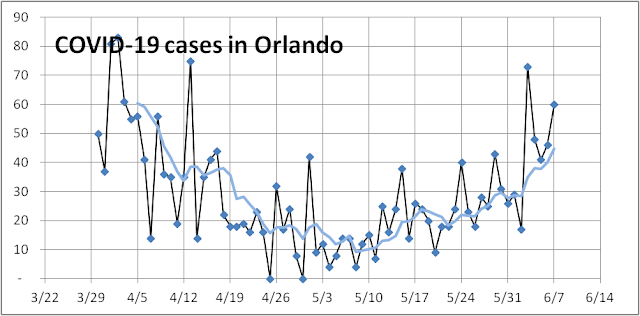
The novel coronavirus can take about 5–14 days to incubate before an infected person starts showing symptoms (if at all) and register as confirmed cases.  So even though case counts stopped declining and started to rise slowly shortly after the May 4th reopening it did not surge until this week.  Moreover, this resurgence in cases is not just confined to the three hot counties of Palm Beach, Broward, and Miami-Dade but is spread throughout Florida.  The figure below shows the daily case count in Orange County that encompasses the city of Orlando.  The same pattern of declining cases in April, mild rise in May, and resurgence in June is observed.  

Governor DeSantis’s move to Phase 2 reopening on June 5th was disappointing especially after he had promised in early May not to reopen further unless the data permitted it.  Clearly, the data shows a resurgence that has not even reflected the full impact of recent massive protests and the reopening of Universal and Disney that are already baked into Florida’s COVID-19 cases for this summer.  DeSantis would have a better chance of relocating the August GOP Convention to Orlando Florida safely if he delayed Phase 2 reopening until testing and contact tracing caught up with the recent surge in COVID-19 infections.

Reopening Florida and Risk of Reinfection

Florida has reopened for business for four weeks now and its experience is similar to that encountered by other states and countries that are trying to reopen quickly after COVID-19 lockdowns.  Reopening the state for business is necessary and should be possible if enough testing and contact tracing resources are made available.  However, testing capacity has always been surprisingly problematic for the US since January 11th when the genetic code for the novel coronavirus was first published and major countries such as South Korea and Germany were able to produce valid tests in quantity.  To date, Florida and the US as a whole still lags behind South Korea, Germany, Taiwan, Australia, and other best-in-class countries in terms of testing completeness and thoroughness.

The figure below shows that testing (brown square against left axis) in Florida has expanded in two months from 6,000 per day in late March to near 24,000 per day now.  The percentage of test results returning positive (blue diamond against right axis) has dropped from near 12% to near 3% now.  All this is very encouraging although the unevenness of the recent data is worrisome especially in light of the recent complaints that (1) the data scientist compiling these data had been summarily dismissed, (2) thousands of tests have been invalidated because of poor handling, and (3) the count of virus tests and serological tests have been mixed inappropriately.  Moreover, the improvement in testing completeness, after briefly touching 1% has now settled around 3.5% — suggesting that the overall Florida population may still be highly infected.   

Another way to check progress in the War against COVID-19 is to look at the trends in daily confirmed cases in Florida.  The figure below shows that in the month of April from roughly the time that the governor declared a state-wide lockdown to begin on April 2nd to the time when he began Phase 1 of reopening Florida on May 4th, the number of daily cases decreased steadily.  So Florida’s lockdown did work to limit the number of cases and deaths in Florida.  However, since the state began to reopen, the number of cases has begun to increase again in May.  Some of this increase may be due to increased testing of asymptomatic and mildly symptomatic cases.  But the recent leveling off in death count at 31 per day and the case fatality rate at 4.4% is worrisome.  If you prefer to check progress via the effective reproduction numberR = 1.03, for Florida right now – borderline problematic in terms of renewed infection risk. 

With Universal Studios set to reopen on June 5th and Disney World scheduled to reopen on July 11th, we are especially worried that South American tourists and snow birders entering their winter will be highly tempted to visit Florida.  Thus far only travel from Brazil has been restricted but all of South America is severely infected and travel from there to the USA should be restricted for the next couple of months. 

California COVID-19 Infection Rate is Growing Again

California (CA) had and still has one of the best records in the war against COVID-19 in the USA with less than half the national average infections per capita and just 13% that of New York State.  At the same time its economy has been hard hit so it has little choice except to try to reopen safely.  But since it started reopening some activities earlier this month, its infection rate has crept up.  Its 7-day trailing average daily rate has increased by 25% from 1,723 to 2,170 per day. 

California has published the most detailed demographic information about its confirmed cases and case fatality rate (CFR) which allows us to examine COVID-19 issues and trends in more detail.  The availability of more data confirms some of our major conclusions from our study earlier this month:

  1. Latinos continue to be infected at a higher rate than any other race/ethnicity, but their death rate is just average for the state.  This implies a lower CFR for Latinos (3.8%) than CA in general (5.4%) but after adjusting for age the difference disappears.  It turns out that the Latino population is much younger than average and a lot of young Latinos are getting infected but not suffering very much from COVID-19.
  2. Blacks seem to get infected and die as often as everybody else (CFR of 9.8% vs 8.6% for whites).  However, after breaking out their data by age groups, middle-aged (35–65 yrs old) blacks seem to have twice the CFR of whites while CFR for the very oldest (85+) are about the same for all races and ethnicities (36%).  We suspect poorer health and comorbidities such as obesity and diabetes for many blacks may play a part but additional data will be needed to draw firmer conclusions.
  3. Curiously, the CFR for Californians (purple line in the graph below) overall is not that different than for Europeans such as Italians and Spaniards implying that CA’s hospital system and population health may not be that great. CA’s CFR may be overstated because the actual infection rate may have been and continues to be higher than the number of confirmed cases.  But if so, this undercounting of confirmed cases could also afflict most other countries except South Korea, Australia, and other best in class countries in terms of testing.  South Koreans continue to set the lower benchmarks for CFR (see blue line in the graph below).  

California’s rising case count and increasing effective reproduction rate R = 1.1 is worrisome, but it may be a result of counting more asymptomatic and mildly symptomatic cases as testing protocols are relaxed.  CA has one of the better testing records of states in the US.  It has tested 4.2% of its population about the same as the US average but its tests have returned 5.8% positive cumulatively (better than 11.3% for the US as a whole) and in recent days, its tests have returned below 3% positives.  If it continues to expand its testing it may continue to reopen safely.  If it cannot, it must slow reopening until testing and contact tracing can catch up to return less than 1% positive results.

Sweden’s Failed Experiment

Sweden’s business-as-usual approach in the war against COVID-19 pandemic has been held up by many conservatives such as Senator Rand Paul as a less costly alternative to national lockdowns adopted by most countries around the world.  We have always maintained that Sweden’s laissez-faire or lazy approach (also tried for a short time by the UK and Netherlands, and still followed by devastated Brazil) is inhumane and does not save lives or even economic fortunes.  Moreover relying on “herd immunity” may be wishing thinking — scientific studies show that coronavirus immunity could disappear after 6 months.

While Sweden has always insisted that theirs is not a herd immunity approach they have always hoped that they could achieve herd immunity quickly to end the pandemic in Sweden.  Their latest antibody study showed that just 7.3% of Stockholmers developed COVID-19 antibodies by late April.  Sweden is losing the war on COVID-19 not just because they failed to impose a national lockdown – they failed in basic epidemiology.  They failed in every aspect of the 4T’s required to successfully manage a Pandemic: test, track, treat, and restrict travel.

  1. Testing has been poor – testing 2.1% of their population but only down to 16% positive results while Denmark’s testing returned only 2% positive results (see table below).  Sweden is the worst of all major European countries in testing.  They try to make up for this deficiency with some random serological antibody testing, but the latter is far less reliable than the viral testing they should be doing.  D
  2. Tracking down all potentially infected is tough if their testing is so spotty but they really make little effort at contact tracing.  D.
  3. Treatment yields them their best grade of B.  They have a good medical system that is well prepared to handle the pandemic, but because their testing is so lackadaisical, they often fail to catch the patients in their early stages of infection.  By the time they are hospitalized and tested they are sometimes left with few good treatment options.  Sweden has attributed their poor case fatality rate (CFR) of 12% to outbreaks in senior facilities with many sick, old people.  Poor testing also causes them to miss the asymptomatic and mildly symptomatic cases and artificially lower the denominator and increase the measured CFR.  The figure below plots CFR against patient age and shows that Swedish (purple line) people fared worse than those in Spain, South Korea, and every major country except Italy.  We don’t know how much of this tragic result is due to poor testing and how much is due to delayed treatment.
  4. Travel restrictions get a C grade.  While their voluntary social distancing and travel avoidance, plus some congregation limits (<50) has worked to flatten the curve, the lack of a national lockdown combined with a lack of thorough testing and tracking is causing them to experience thousands of more deaths than their Nordic neighbors: Denmark, Norway, and Finland (see table below).  Sweden has flattened the curve but there is no sign that their pandemic is easing or under control.  Sweden has the highest coronavirus death rate per capita in the world, with an average of 6.1 deaths per million inhabitants a day over the last 7 days. 

Our criticism of Sweden is not that they did not impose a national lockdown — there are countries that have managed their COVID-19 crisis without draconian lockdowns.  But if they chose to leave their country open domestically, they had to implement the other 3Ts: test, track, and treat thoroughly.  Iceland, Norway, and Denmark did not impose stay-at-home orders and left most businesses open.  They all controlled their infection with thorough testing, contact tracing, and early treatment.  Sweden should have done the same and now many top officials in the country are reconsidering their strategy.    

CountryInfections
/million
InfectionsDeathsDeaths
/million
Fatality (CFR)Tests
/million
 Testing PositiveMedian Age
Sweden        3,291     33,188    3,992        39612.0%  20,79816%41.1
Denmark        1,951     11,289       561          975.0%  90,8952%42.3
Norway        1,541        8,340       235          432.8%  42,4194%39.2
Finland        1,186        6,568       306          554.7%  29,8934%43.1
Iceland        5,290        1,804         10          290.6%170,7453%37.5

Update International Travel Ban List Now

Many countries that have been locked down for over a month are now seeing some stabilization and are trying to reopen.  To improve their chances to reopen successfully, they have all ramped up their testing and tracking capabilities and continue to restrict foreign travel.  While the efficacy of International travel bans are debatable, most scientists believe that for countries to successfully manage a domestic test and contact tracing program, it would help to restrict travel from global hotspots to minimize reinfections.  Once a country has established a comprehensive domestic tracking program and controlled community spread, then they could allocate more resources to testing and contact tracing all foreign travelers. 

The current CDC list of restricted countries was last updated on March 14th,  nearly 10 weeks ago, and urgently needs to be updated to include many new hotspots.  Just today, Russia and Brazil overtook many of the European countries that had been suffering as number 2 and number 3 on the list of most infected countries.  Not only do they have a high number of infections and infections per capita but most importantly they have exponentially growing infections with effective reproduction numbers, R >1, and worrisome doubling times.  That means that a high and rapidly growing number of their citizens are getting infected every day.  Countries like Italy, Norway, Switzerland, and Germany can probably go off the list since their R values have fallen significantly below 1 and their newly confirmed cases have been declining for several weeks.  Removing these countries, however, is not as important as adding the highly infected countries to the CDC list that is used to screen hospital patients, air travelers, and other sensitive venues.  An outdated list makes the USA highly vulnerable to reinfection.  This is especially important as the USA reopens tourist spots like Disney World that are travel magnets for South Americans from Brazil, Chile, and Peru who are entering into their high season for flu infections.  Moreover this travel list should be updated based primarily on public health rather than political or economic concerns.  Let’s not repeat the same error we made in February when we were so focused on China that we failed to recognize the hotspots developing in Europe and let infected Europeans into the USA.  

CountryInfectionsInfections
/million
DeathsDeaths
/million
RDoubling time (days)Fatality Rate
USA1,591,991        4,821 94,994        288     1.06506.0%
Russia   308,705        2,116    2,972          20     1.06301.0%
Brazil   293,357        1,382 18,859          89     1.26116.4%
India   112,028             81    3,434            2     1.20143.1%
Peru   104,020        3,160    3,024          92     1.20152.9%
Chile      53,617        2,808       544          28     1.27111.0%
Mexico      54,346           422    5,666          44     1.211410.4%
Pakistan      45,898           208       985            4     1.19152.1%
Bangladesh      26,738           163       386            2     1.25111.4%
Indonesia      19,189             70    1,242            5     1.20166.5%

When Is an Outbreak Controlled?

Many countries around the world are struggling with the question of when and how to reopen the country after lockdown.  Many, including the UK and Germany, have come to rely on a parameter called R or R0 as a benchmark for reopening and staying open.  What makes R so powerful?  In epidemiology, R0 is the pathogen’s basic reproduction number and represents the number of new infections caused, on average, by a single contagious person.  R, or the effective reproduction number (sometimes designated as Re or Rt), will start at R0 and should decline over time as the population gets infected, builds immunity, and mitigation measures are activated. 

R = (1 - P) x R0

where P is the percentage of the population that is immune or out of the pool of susceptible individuals.  If 60% of the population is vaccinated or isolated then only 40% can be infected and R is only 0.4R0.  R0 of the novel coronavirus has been variously estimated at between 1.5 and 3.5, with the WHO currently estimating 2.0 to 2.5.  When R is reduced below one, a contagious person can infect just one other person and the number of newly confirmed cases stabilizes and declines, and the outbreak can be short-circuited.  When R0 is 2.5 the above equation requires that 60% of the population get infected to achieve “herd immunity” to control an outbreak. This does not end the infection which in this example would continue until 88% of the population is infected.  Measuring R0 is therefore very important but estimating its value, while the pandemic is raging, is problematic and highly model or assumption dependent.

As an example of the wide range of estimates possible for R, we look at two models.  One of the more interesting infectious disease forecasting website is EpiForecasts which provides models of the COVID-19 pandemic for hundreds of countries and subnational regions including all the states in the US.  They currently estimate R, the effective reproduction number, for the US at 1.04 (with a 90% confidence range of 0.9 to1.2).  A few states such as New Jersey have R < 1, but most states have R >1 such as Florida at 1.1 so their expectation is that case counts will increase as the states reopen.  Their forecasts appear to be slightly more pessimistic than the widely followed IHME model and others who increased case and death count forecasts after states started to reopen two weeks ago.  A few models, such as Rt Covid-19, are more sanguine and estimate a lower R for the US as a whole (~0.85) and R > 1 for only one state, Minnesota.  Their model suggests that the COVID-19 infection is under control in the US and states are safe to open.  Their model for Florida shows a current estimate of 0.89, increasing slightly and with widening uncertainty after the state reopened recently. 

Given this wide variability in estimating R, with one model saying no and another saying yes, we prefer to go back to the original US recommendation for benchmarking safe reopening strategies.  One of its gating criteria simply requires that states demonstrate 14 days of declining confirmed case count.  By this measure, Florida was one of the first of a handful of states to qualify.  Now two weeks later, Florida wants to move on to phase 2.  The figure below shows that as of May 1st, the state met the criterion for phase 1, and as of May 15th it failed the same criterion to open further.  While we expected this might happen as the state tested more widely, it would seem wiser for the state to proceed more cautiously.  After all, if the outbreak does return, i.e. R > 1, the need to shut down again could cost more in the end.

Page 7 of 12

Powered by WordPress & Theme by Anders Norén